Bedfordview sits about 1,640 m above sea level, and central Johannesburg about 1,750 m. That is higher than Denver, the American "Mile High City". Every run on the Highveld is a little harder than the same run at the coast, because each breath carries less oxygen. This article explains what altitude does to your running, how to adjust your training at home, and why many Gauteng runners find coastal races feel easier.
In short:
- At altitude the air pressure is lower, so each breath delivers less oxygen to your muscles.
- In a laboratory study, trained runners lost about 6% of their maximum oxygen uptake for every 1,000 m of altitude.
- Train by effort and breathing, not by sea-level pace targets.
- At the coast there is more oxygen in every breath, so race paces often feel easier, but heat and humidity can take that advantage away.
Is Johannesburg high altitude?
Sports scientists usually call 1,500 to 2,500 m "moderate altitude", and the Highveld falls squarely in that band. It is not high enough to make most people ill, but it is high enough to change how running feels. Visitors from Durban or Cape Town often notice they are out of breath on hills that locals barely think about.
What altitude does to your body
The air at 1,640 m still contains the same proportion of oxygen, about 21%, but the air pressure is lower, so less oxygen is pushed into your blood with each breath. Your heart and lungs have to work harder to deliver the same amount of oxygen to your muscles.
A study published in the European Journal of Applied Physiology measured this directly. Trained endurance runners were tested in a pressure chamber at simulated altitudes from 300 m to 2,800 m. Their maximum oxygen uptake (VO2max) fell in a straight line as altitude increased: about 6.3% for every 1,000 m. How long they could hold a fixed hard pace fell even more sharply, by about 14.5% per 1,000 m. The decline started as low as 800 m, so altitude is not something that only matters on mountain tops.
How to train at altitude
- Run by effort, not by pace. Online training plans are usually written for sea level. If a plan says "easy pace", find the pace at which you can talk in full sentences on the day, and accept that it may be slower than the plan suggests.
- Expect a higher heart rate. At altitude your heart beats faster for the same pace. If you train with a heart-rate monitor, use zones set from your own tests here, not formulas.
- Respect the hills. Bedfordview's routes are hilly, and altitude makes climbs feel steeper. Keep your effort even on the way up and let gravity help on the way down.
- Drink and protect your skin. Highveld air is dry, and the World Health Organization notes that UV levels rise by about 10% with every 1,000 m of altitude. Hydrate and use sunscreen, even on cool mornings.
Why coastal races often feel easier
When you travel from the Highveld to a race at sea level, in Durban, Cape Town or Gqeberha, there is more oxygen in every breath. Many local runners notice that their usual training effort produces a faster pace at the coast.
The science of "live high, train low" helps explain why. In a well-known study, competitive runners who lived at 2,500 m and trained at 1,250 m for four weeks improved their 5,000 m time at sea level by about 13 seconds on average. The improvement was linked to more red blood cells and a higher VO2max. Runners who lived and trained high, or lived and trained at sea level, did not improve in the same way.
Living in Bedfordview is not the same as an altitude camp. Our altitude is lower than in that study, and we also train up here, so do not expect miracles. But the basic physics works in your favour when you go down to race.
The catch: heat and humidity at the coast
A summer race in Durban can be hot and humid, and heat slows you down more than the extra oxygen speeds you up. Start conservatively, run by feel for the first few kilometres, and drink to thirst. If you are running Comrades or Two Oceans, practise in warm conditions where you can, and do not set your pace targets on the assumption that the coast will make you faster.
Coming to race in Johannesburg?
If you live at the coast and are racing on the Highveld, expect your usual pace to feel harder, especially on hills. Start more slowly than you would at home, take walk breaks on long climbs if you need them, and give yourself a little more time than your sea-level results suggest.
Run the Bedfordview hills with us
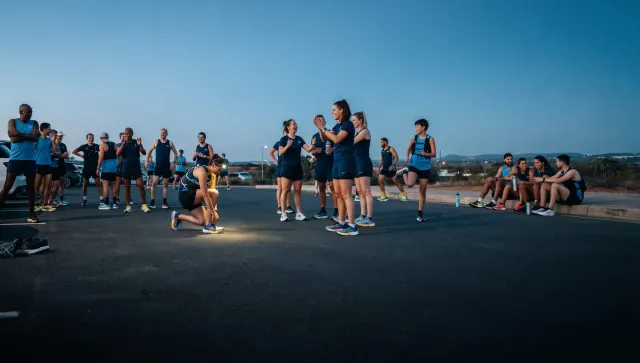
Altitude and hills are part of the character of running in Johannesburg's eastern suburbs. Bedfordview Athletics runs from the top parking lot at Virgin Active Bedfordview on Tuesday to Friday at 05h00, with long runs on Saturday and Sunday at 06h00, and groups for every pace. See the training runs and our favourite running routes, or read our 12-week half marathon plan.
Questions runners ask
How much slower will I run at Johannesburg's altitude?
It varies from person to person, and well-trained athletes are often affected more because they rely on high oxygen delivery. Laboratory studies suggest a few percent at Highveld altitudes. Use effort and breathing as your guide.
Does living in Johannesburg give me an advantage at the coast?
Often, yes, because there is more oxygen per breath at sea level. Heat, humidity and the different terrain can cancel it out, so run the first part of the race by feel.
Do I need to acclimatise before a race at altitude?
Your body starts adapting within days, but full adaptation takes weeks. For a single race, the most useful thing is to adjust your pacing expectations and start conservatively.
Sources
- Wehrlin JP, Hallén J. Linear decrease in VO2max and performance with increasing altitude in endurance athletes. European Journal of Applied Physiology, 2006.
- Levine BD, Stray-Gundersen J. "Living high-training low": effect of moderate-altitude acclimatization with low-altitude training on performance. Journal of Applied Physiology, 1997.
- World Health Organization. Radiation: ultraviolet (UV) radiation.